
You could say that as a modeller, I grew up with the Oil Paint Rendering technique. I actually bought a Tankart book before buying my first kit! OPR and the Tankart books are creations of Mike Rinaldi, and his books are the reason why I’m a modeller.
Those expensive tomes are still here in the PL office and I've used OPR in some way since my early days in modelling; but I’ve never given much thought to whether this technique is actually common knowledge. When I mentioned OPR somewhere recently, the conversation went…
“What’s OPR?”
“Oil paint rendering.”
“What’s oil paint rendering?”
What rendering actually is…
To understand what OPR is about, let’s forget about oil paint for a minute and focus on “rendering”. Oil paint is just the medium; rendering is the process.
Render [verb]:
[art] depict artistically; recreate light, shade, texture, and colour
[graphics] apply colour and shading to make an object appear three-dimensional
The dictionary definition doesn’t give the full picture, of course: it overlooks the one thing which everyone — from architects to 3D artists to painters — has in common when they render their artwork.
And that’s the thought process. Mike Rinaldi borrowed the word from his own art background because he realised that he was thinking about his process in the same deliberate way as artists think about theirs.
…and what it’s not
Rendering is not randomly applied and neither is OPR. When modellers are told about OPR, they sometimes ask a follow-up question: “so, it’s like oil dots?” Not at all. The oil dot idea is a randomised and not reality-based method of post-shading, so its only commonality with OPR is the medium.
The fact that rendering is deliberate and thought through is one of the things which differentiate it from finishing styles which rely on randomness.
So what can OPR do?
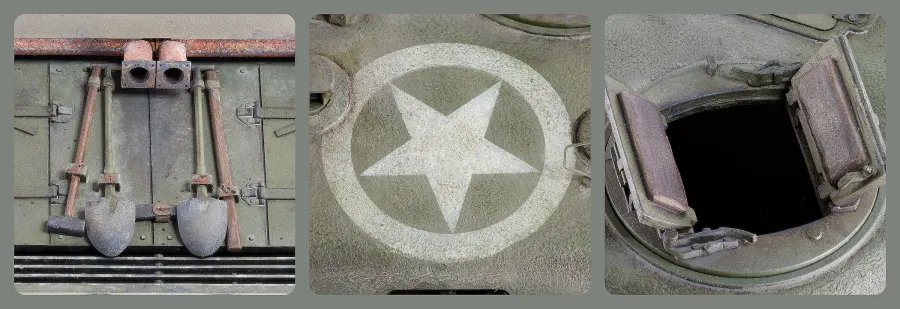
- Highlights and shadows
- Paint discolouration and fading
- Fine dust and dirt
- Stains, streaks, and splashes
- Rust, chipping, and scratches
- Wear on tracks, rubber, and tools
- Worn whitewash and markings
- Figure post-shading
How’s it done?
This is an explainer, not a tutorial, but a primer is helpful.
Mostly, OPR begins with some variation of broadly the same technique. We use a fine-point brush to apply a very small amount of paint, usually with a smidge of thinner, to the surface. Sometimes, just a slightly damp brush is enough. The paint is worked and blended out with a different brush, such as a filbert or chisel, which may be damp or dry.
We can expand the range of possible effects by adding other media: mix in a little pigment to add volume and texture; use matte or gloss oil or alkyd media to make a wider range of finishes.
A cornerstone of OPR is that it can and should be applied in several layers. Which effects you use, the order in which you apply them, and whether you repeat them is entirely up to you; but as a general rule, OPR isn’t finished in a single treatment.
Essential items:
- High quality artists’ brushes: fine point, filbert, flat, and chisel
- Absorbent material, such as cardboard, to use as a drying palette
- Highly refined spirit thinner (lower odour indicates milder thinner)
- A few high quality oil paint colours
Why oils work so well
We use oil paints for OPR because they are easily blended and dry slowly. Being able to choose colours of reduced opacities makes it a cinch to replicate different effects. For instance, you can use a ‘transparent’ colour with gloss medium to make fresh oil splashes. As a rule, the better the paint quality, the finer the pigment and the easier it is to get a nice result. If you invest in high quality paints, you also get some value back from the high pigment density and low oil content. I have an explainer about oil paint quality.
If you use budget or mid-range linseed paints, you need to place the oil colours on a drying palette for some time before they can be used. Highly dense paints with matte drying oils can be used pretty much immediately.
OPR summed up
- It’s flexible and quite genre-agnostic
- It’s precise, deliberate, and targeted
- It can be applied in multiple layers
- Keep a clear picture of the final appearance in mind
- It takes time to complete the process
- Mastering it requires some practice
OPR gets pigeonholed as just a type of weathering, which I suppose depends on how you define weathering.
To me, it’s more than that: it’s a way of thinking about painting and finishing models and figures using a toolbox of interrelated effects. You reach for whichever tools you need and combine them to realise your image of how your subject should be rendered.


Add your comments