
If you are just starting to discover what you can do with oil paint on your scale models, let me explain why I think that you should invest in higher quality artists’ oil paints.
I've used paints from a mix of manufacturers and price points, from Ammo by Mig and Abteilung 502 to Winsor & Newton and from Sennelier to Old Holland and Gamblin. My opinion is based on my experiences with using those products for rendering, weathering, and figure painting.
Consistency
Good quality artists' oils have a higher base level of quality, so each colour of a particular category (opaque, transparent, etc.) performs very much the same as another. This makes it easier to use consistently without having to adapt your workflow to cope with the paint's variability.
Single pigments
More expensive paint ranges tend to comprise more single-pigment colours. These are made with only one pigment rather than a blend of two or more. The reason why this matters is because mixing multi-pigment paints can often produce unexpected results. Mixing without knowing exactly what you're mixing can feel like alchemy.
Transparency [of information]
In any good quality artists’ oil range, every colour is clearly categorised according to its important characteristics, including opacity and the number of pigments which each colour comprises. The model paint brands don’t provide this crucial information.
A note about colour names. Obviously, artists' paints are not usually named to reflect intended usage, so you won't find anything called Track Rust or Engine Grime. We all know that such naming schemes are calculated to make us buy more colours, even those which look remarkably alike once they’re in your hand. You just need to get used to choosing colours rather than names.
Density
Good quality oils have a higher pigment density, which makes a big difference to us modellers because we only use tiny amounts at a time. If there’s not enough pigment in the mix, the colour can almost disappear as it dries. For comparison, try making an identical pin wash mixture with low- and high-quality paints, apply each in the same way, and wait for them to dry. You will probably want to reapply the low-quality mix.
Oil quality
Some of the best oil paints use safflower or poppy oil, either in light colours (because they are clear and resistant to yellowing) or in the whole range. Compared to linseed oil, the finish is transparent and matte. I've found that safflower is far more tolerant of being used with little or no drying on cardboard, which is handy if you’re pushed for time. It also seems to cure more quickly and with better resistance to reactivation.
Results
The best artists’ oils are not only better quality than cheap equivalents, but are actually easier to apply using modelling techniques. In my experience, colours can be blended on the surface better, being less prone to smearing, they adhere better, and the colours cover better. All welcome characteristics, but especially so if you paint figures with oils over acrylics.
Economy
A tube from Abteilung 502 costs about 20p per ml (at the time of writing). The cheapest of my favourite art brands — Sennelier — starts at the same price per volume for its lowest tier, yet its paint is consistently far denser so there is far less wastage. Placing equal amounts of each onto cardboard and watching the oil leach out is a real eye opener.
Here's a timelapse sequence showing how typical colours from three similarly priced brands react over time.
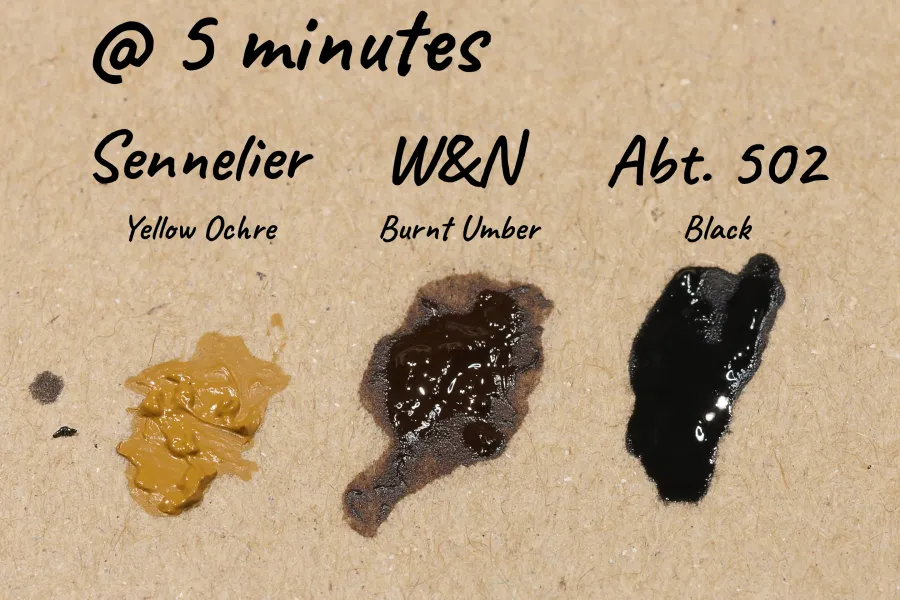
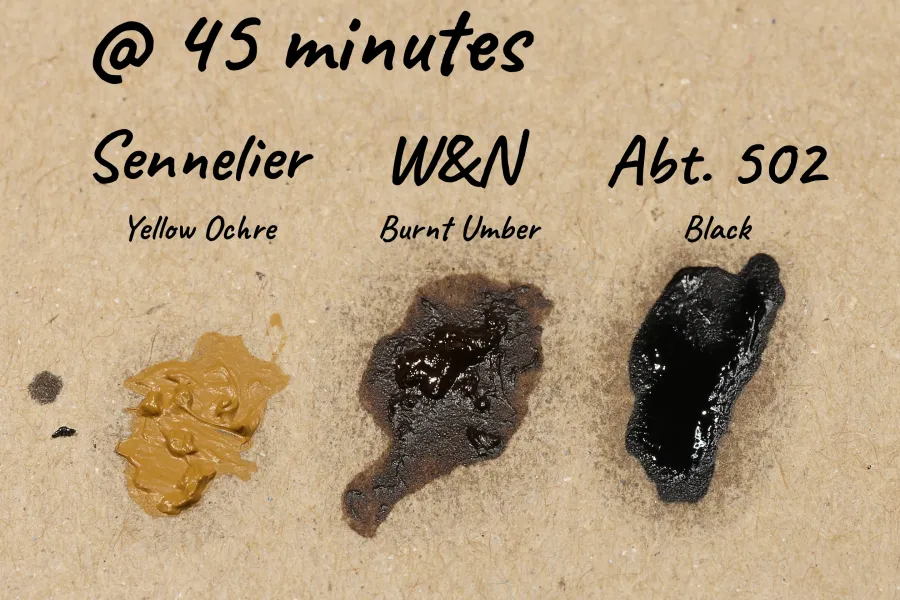
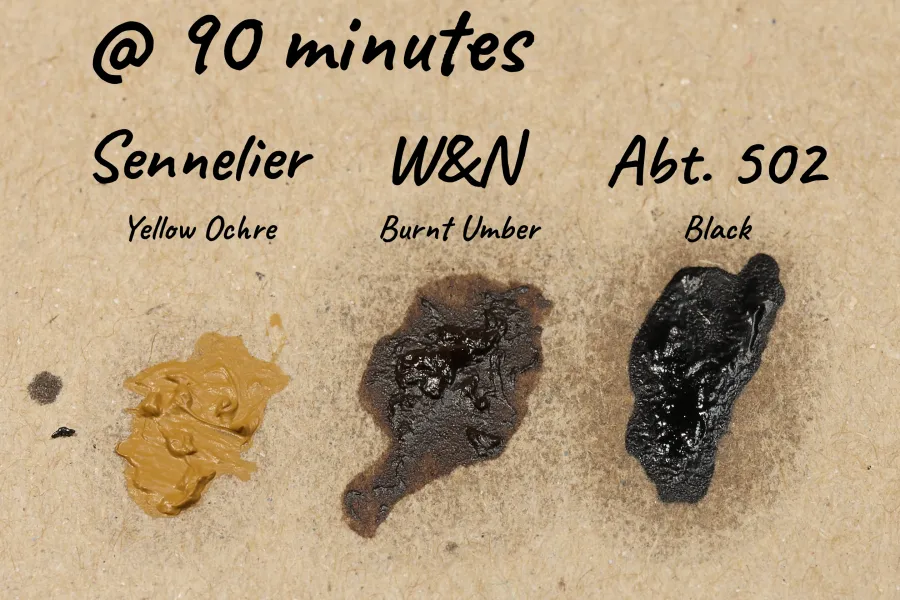
These photos speak volumes. The Sennelier has lost by far the least oil and volume over time and it's the least glossy. Abteilung 502 has lost a lot of oil and yet it's still the most glossy; while Winsor and Newton has lost a bit less oil, but most of its volume.
So if you're trying to make a pure value judgment, don't just base it on price per tube, or even per millilitre, because it's clear that dense paint will go further.
Yes, most artists’ oils are tiered into several price ranges, so you need to pay more if you want certain pigments. Other than over charging for the cheaper pigments, the only alternative would be to do what the model paint brands likely do: minimise the use of more expensive pigments (and, I suspect, rely more heavily on pigment mixes).
Recommendation
This is just my preference based on my experience. The cheapest oil paint which I recommend is — no surprise — Sennelier, which is an all-safflower range. It has a fine pigment and good smoothness without smearing. Pigment density and volume ranges from good to excellent; across the whole range, it's much denser than similar Winsor & Newton or Abteilung 502 colours. The more matte finish makes it the perfect choice for rendering and weathering techniques; and it's good for the oil-on-acrylic method of painting figures. If you choose carefully and get used to mixing, you won't even need that many colours.
Add your comments