
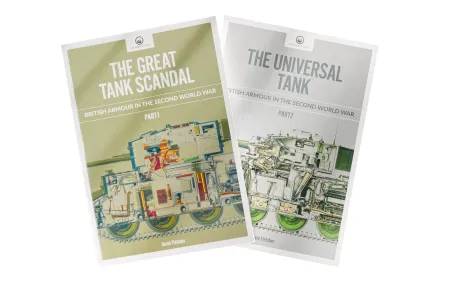
I’m going modelling-adjacent for this month’s review, looking at the Tank Museum's reprints of historian David Fletcher's two-part critique of British AFV design in WWII.
The author
Long before YouTube became a thing and his moustache became famous via the Tank Museum channel’s Tank Chats series, David Fletcher was writing a long list of books about AFVs, specialising in British machinery from the 1930s and ‘40s. Back in 2021, the Tank Museum* republished a series of his older out-of-print titles with a new thematic style.
Fletcher retired from presenting in 2022, and Tank Chats itself went the same way not long afterwards, presumably due to running out of tanks to chat about… but the reprints are still readily available.
* (It’s typically British to call things “the thing” and expect everyone else in the world to know which of those things we’re on about. Sorry about that.)
British Armour in the Second World War
The full range of the Tank Museum reprints includes titles about the development and specifications of particular tanks, such as Cromwell and Churchill; early British armoured cars; interwar development of British tanks and tactics; and these two books which cover the development, production, and deployment of British tanks from 1939 to 1945.
Part 1: The Great Tank Scandal
The title may seem like it belongs in this era of clickbait, but it references a contemporary article which was written on the premise that there was something scandalous behind the equipment in which tank crews were going to war.
But Fletcher points out in the preface that there was no specific political scandal behind it: more an unfortunate concatenation of limiting factors. He notes that tank design experience had atrophied; engineering and manufacturing resources were geared toward other industries and war needs; while indecisive and incompetent decision makers hampered progress. Some of this was avoidable, some not so much.
But this book is not a political history. Instead, it views the military, industrial, and political problems of the time through the lens of vehicle design/development and procurement. It works as an introduction to early-war armoured vehicles and their deficiencies, but I didn’t find it as illuminating about the root causes as I had expected. The most insightful chapters are the first, which touches on budgets, and the fourth, some of which looks at the decisions of ministries and departments.
But other than that, using a history of AFVs to make a point about the military-industrial system which created them isn’t entirely convincing. If we could view it that way around, then some other nations must surely have had their own contemporaneous ‘great tank scandals’.
Part 2: The Universal Tank
It’s not as though the problems were never recognised, but under pressure to meet the demands of rearmament and replacement, it must have been unfeasible to suggest “stop making so many designs of variable quality and start making one really good one.” And where was this design anyway?
That’s what the second book answers… sort of. It starts with Churchill’s performance in Tunisia and how this influenced the debate about the 6pdr versus 75mm, but takes the scenic route via armoured cars and Valentines. After that, the opinions of three armour officers of the north African campaign are interesting, before we’re sidetracked again by flail tanks. Wheels and flails make more appearances before the end.
Chapter three outlines the process which led to Cromwell, with an insight into the difficulties involving Nuffield and Leyland. After another wheeled meander, it describes the Vanguard project and Churchill developments, which segue into mine ploughs, more flails, and DD tanks.
It continues a bit off track until chapter six, which picks up post-Cromwell developments: Challenger, the 17pdr gun, and the designs which might have used it instead of Firefly. Tortoise trundles briefly into view, too. It also describes work to refine the initially tricky Cromwell into a decent tank and there’s a comparison of the pros and cons of vertical and sloped armour by a Colonel Gordon-Hall. Fletcher thinks that he knew his stuff, so if you hear anyone criticising vertical armour, quote Gordon-Hall to them.
The final two chapters are about NW Europe, including a précis of the official assessments of tank performance. There’s some interesting stuff there. However, it’s only in the last few pages that it directly discusses the arrival of Centurion, which could lay claim to be the Universal Tank of the title. Then again, given that it only turned up after the smoke cleared, maybe that’s fitting.
Conclusion
So the first book isn’t very scandalous and the second book isn’t really about Centurion or any other possibly universal tank. It’s partly about the road taken towards a universal tank, but it’s also a general history of British AFV development from 1943-45. Just as the first book is partly a history of 1939-43.
They each make quite interesting introductions to said history, and we get to see some of what went on behind the scenes, but it feels at times as though the curtain wasn’t quite pulled all the way back. It may have been better to focus on battle tanks because the frequent drifts off-topic diffused the central point of discussion, which was intended to be how Britain got into such a mire with tank design and how it got itself out of it. I found the second book to be more informative about this than the first.
A good revisionist alternative is The Second World War Tank Crisis by Dick Taylor, which I think does a good job of examining the topic from a different direction to explain what went wrong and why. It also tackles some of the declinist myths which grew up around the subject. If you want to go more deeply into the topic, I can recommend this along with Taylor’s Armoured Warfare in the British Army, 1939–1945 as a companion.


Add your comments