
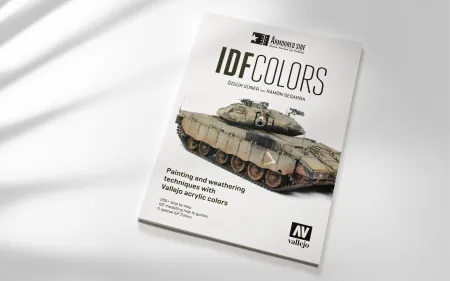
Don’t judge a book by its cover, the saying goes, but you should at least know what to expect, so let’s find out if this delivers on its promise.
- IDF Colors — Painting and Weathering Techniques with Vallejo Acrylic Colours
- ISBN: 9788409179930
- Typical price: £25
- From Aviation and Military Book Centre
The content
The compact size of 113 pages and the tagline of “painting and weathering techniques” suggest that it’s strictly a ‘what, how, and why’ of finishing.
Instead, it kicks off with the inevitable bit of advertorial for a paint set and a brief section about IDF-specific construction tips, followed by what amounts to five magazine build articles. Most include some limited coverage of the construction phase, which suits a magazine format but is irrelevant in this supposedly focused context. And like magazine articles, they are light on insight.
The tips are alright as far as they go, though I could suggest easier solutions for surface texture and the ball-and-chain problem. Any reader who actually does want to know how to build these vehicles is probably not best served by a slim book with an identity issue.
If the editor was thinking of producing a more comprehensive all-round guide to building and finishing IDF AFVs, it would have taken a much bigger book to do it justice. Adam Wilder got this right when he produced two complimentary volumes: one devoted to construction and the other to finishing. Two markets, two topics, two books.
A book of this size needs to be laser-focused. I wish that the decision makers had opted for just two or three in-depth contributions and devoted the space entirely to finishing. I also wish that for £25 they had chosen a more comfortable typeface, caught the typos, upped the print resolution a bit, and ensured consistently better images.
But does it meet the brief?
In a word: no. If you want to fully understand how to produce realistically finished IDF models to a high standard, you won’t gain any further knowledge than you can glean from free resources.
I’ve mentioned ‘what, how, and why’. To be insightful, an in-depth explanation of a finished model should include not just what the modeller did, but exactly how it was done and why he did it. This book outlines ‘what’, but is light on ‘how’ and forgets about ‘why’.
So that’s the stated aim unmet. What about the obvious ulterior motive, which is to demonstrate the effectiveness of Vallejo’s weathering products and persuade you to buy some. Does that work?
Not exactly. If you want more modellers to use water-based weathering products, your examples need to be on point. You need to demonstrate that it can produce as refined a result as the alternatives; counter any perception that it can’t be blended; and explain in enough detail how to get the best from it.
This book doesn’t do any of those things quite well enough to sell water-based weathering as a genuine alternative.
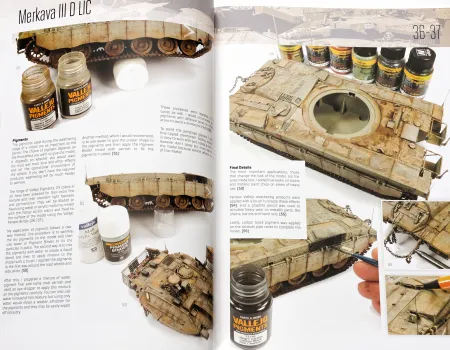
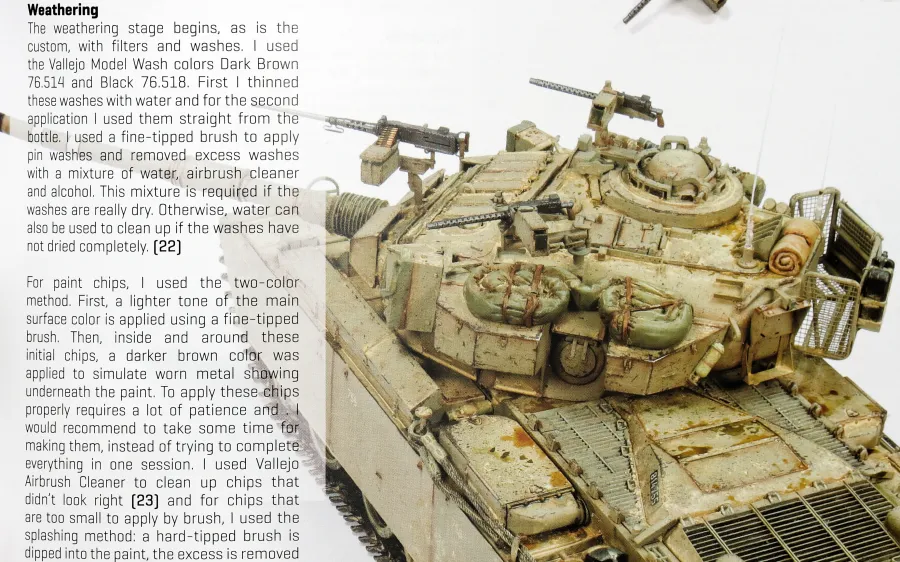
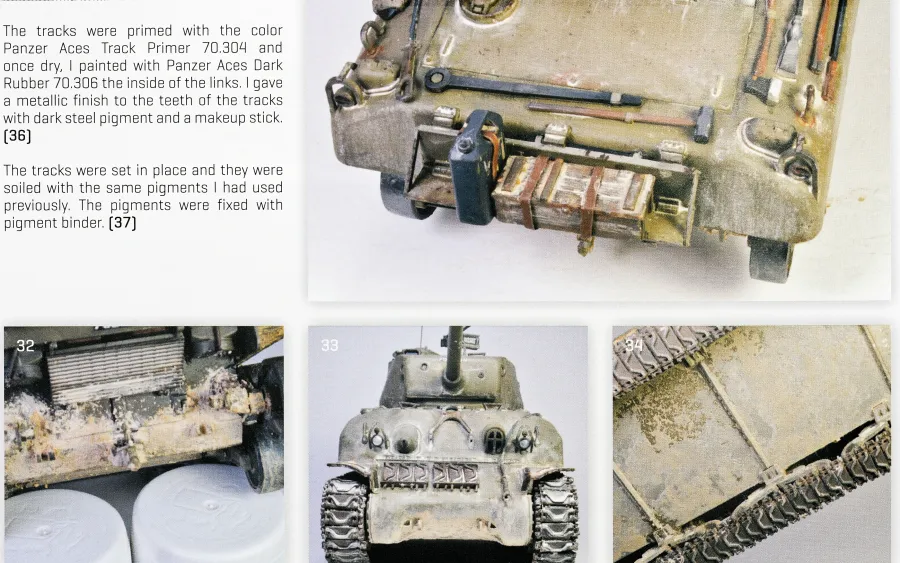
It begins well with Özgür Güner’s Merkava IIID and the next two, also from Özgür, are quite good. Unfortunately, the final two contributions are not up to Özgür’s level and the last in particular is actually poor with untidy hand-painted details and carelessly unblended dust and stains. This has no place in a magazine, never mind a book. Even I can do a bit better, which is saying something!
As a whole, this book probably won’t convince the sceptical fence-sitter not to invest in oil paints and media and go H₂O instead.
You may already know that I’m an evangelist for oils, but I’ve used water-based techniques as well — even on the same model (such as my Magach) — and they really do have their uses. I wouldn’t suggest that anyone confine themselves solely to water-based unless they intend to view it as a challenge and a discipline in its own right, but don’t overlook them either.
Summary
- Lacks focus, depth, and insight
- Nothing about why any particular thing was done
- Variable quality of contributions
- Undersells the potential of water-based weathering

Add your comments